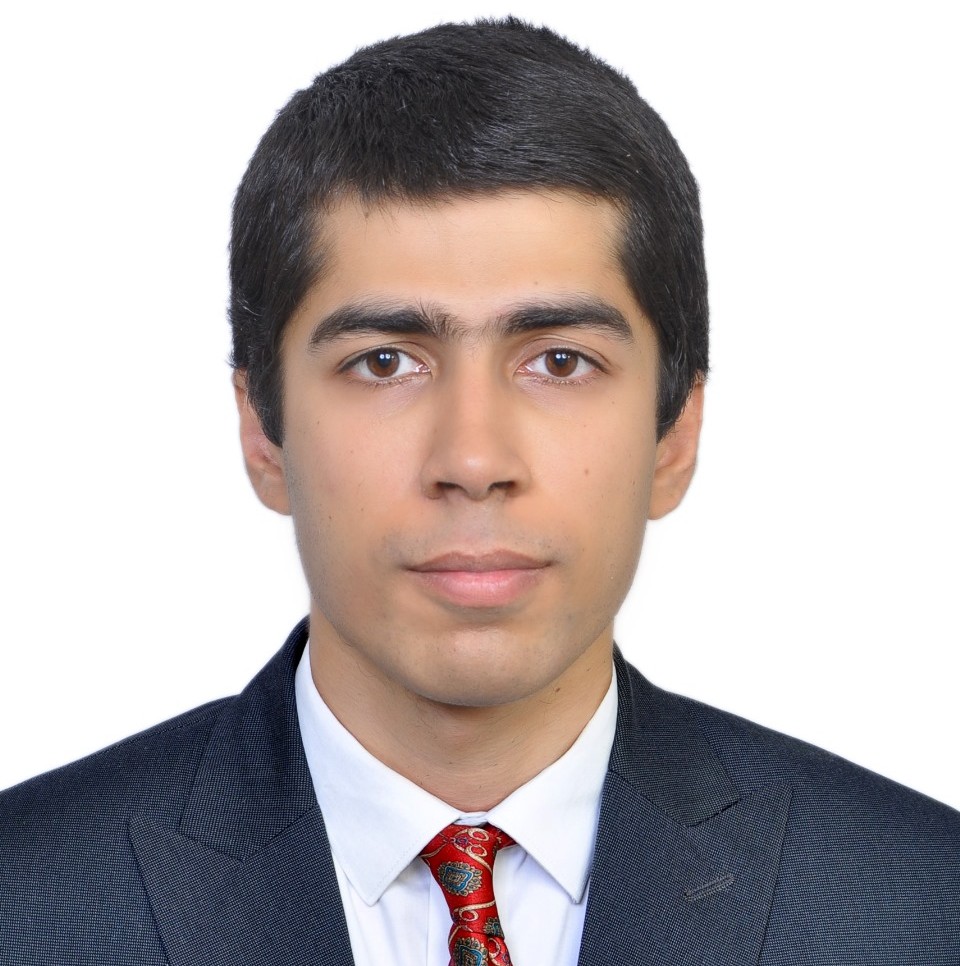
Welcome
About Me
I graduated Magna Cum Laude with a Bachelor’s degree in Electrical Engineering, specializing in Computer Engineering, from the National University of Computer and Emerging Sciences (FAST-NUCES), Lahore Campus, Pakistan, in June 2023.
Following my graduation, I worked as a Research Assistant at the Smart Networking Research Group at FAST-NUCES from February 2023 to September 2023, under the supervision of Prof. Saima Zafar. We achieved a novel milestone by pioneering the first application of High-Level Synthesis for Machine Learning in medical applications. Our work was published in IEEE Embedded Systems Letters (Impact Factor: 1.7).
I chose to take gap years to further explore my academic interests—a decision that guided me toward pursuing a PhD in Computer Science. As an incoming doctoral candidate and dedicated researcher at University of Massachusetts Amherst, I am grateful to my family for their steadfast encouragement throughout this pivotal chapter of my life.
I am grateful to Prof. Stefan Krastanov of Manning College of Information and Computer Sciences at the University of Massachusetts Amherst for his wonderful mentorship and guidance as I embark on this new journey.
Education
- B.S. in Electrical Engineering, National University of Computer and Emerging Sciences, in Lahore, Punjab, PK, Fall 2019 - Spring 2023
- Research Area: Deep Learning Accelerators, High Level Synthesis, Hardware-Software Codesign Workflow
- Publication: Feroz Ahmad, Saima Zafar, “SoC-Based Implementation of 1D Convolutional Neural Network for 3-Channel ECG Arrhythmia Classification via HLS4ML”. Published in IEEE Embedded Systems Letters Early Access (IEEE ESL).
- Supervisor: Prof. Saima Zafar in the Smart Networking Research Group (SNRG) at NUCES.
Work Experience
- Research Assistant, UMass Amherst, Sep 2025 - Present
- Incoming first year PhD student at UMass Amherst, working as Research Assistant under supervision of Prof. Stefan Krastanov.
Gap Year Journey
- Open Source Contributor, Oct 2023 - Aug 2025
- My completed work includes contributions to QuantumClifford.jl and bug bounties resolved under Quantum Savory’s program:
- Highlighted contributions:
- Invented [[n² + m², (n - rank([C ∣ M]))² + (m − rank([C ∣ M]ᵀ))², d]] Quantum Tillich-Zémor Code
- Completing the non-Clifford capabilities
- Compute the minimum distance of QLDPC using Mixed Integer Linear Programming
- D-dimensional surface and toric codes via Oscar’s chain complexes and GF2 homology
- Support non-abelian Lifted Product code by generalizing to non-commutative group algebras
- Extending the capabilities of two-block group algebra codes using finitely presented groups and group presentations
- Highlighted contributions:
- Mentor: Prof. Stefan Krastanov, University of Massachusetts Amherst.
In addition,
- Developed software for Quantum Optimal Control Theory and Amazon-Web-Services (AWS) Braket.
- 3rd rank globally on unitaryHack 2024 Leaderboard. Packages contributed to: Braket.jl, BraketSimulator.jl, Piccolo.jl
Work Experience
- Research Assistant, NUCES, Feb 2023 - Sep 2023
- Organization: National University of Computer and Emerging Sciences, Lahore, Pakistan.
- Developed a pioneering approach of HLS4ML’s first real-use case outside of Physics in the Embedded Systems, generalized for all applications from the incoming signal in 1 dimensional.
- Worked on high level synthesis (HLS) based hardware-software co-design flow deep learning accelerators for human bio-potential classification with implementation on System on chip (SoCs)
- Research Output: SoC-Based Implementation of 1D Convolutional Neural Network for 3-Channel ECG Arrhythmia Classification via HLS4ML
- Supervisor: Prof. Saima Zafar
- Officier Under Training, June 2022 - Sep 2022
- Water and Power Development Authority, Pakistan
- Worked at Ghazi-Barotha and Tarbela powerhouses as OUT, gaining understanding of energy sector operations. Field experience from SIGMA, SWAT, PTESU, and DTESU industries.
- Completed a literature review of the current emerging technologies in the monitoring of processes in the powerhouse facility.
- Provided recommendations and suggestions for how Machine Learning can be used to improve the efficiency, reliability, and profitability of hydro power powerhouses.
- Supervisor: Mr. Ahmad Kamal
Research Interests
- Research Area: Quantum Error Correction